
Tuesday, June 10, 2025


Sunday, September 4, 2022


Wednesday, July 20, 2022
MANIFESTO OF THE COMMUNIST PARTIES OF LATIN AMERICA IN DEFENSE OF THE NATIVE PEOPLES AND ANTI-CAPITALIST AND ANTI-IMPERIALIST STRUGGLES.
 |
| Cacique Guaicaipuro |
MANIFESTO OF THE COMMUNIST PARTIES OF LATIN AMERICA IN DEFENSE OF THE NATIVE PEOPLES AND ANTI-CAPITALIST AND ANTI-IMPERIALIST STRUGGLES.
[Spanish language original text: https://prensapcv.wordpress.com/2022/05/27/manifiesto-de-partidos-comunistas-de-latinoamerica-en-defensa-de-los-pueblos-originarios-y-de-las-luchas-anticapitalistas-y-antiimperialistas/]
https://prensapcv.wordpress.com/
The invasion of the Spanish and Portuguese empires in the lands of Abya Yala, of Pindorama or Tawantinsuyu[1], between the XV and XVI centuries, resulted in the enslavement, expropriation and death of millions of indigenous peoples. As a result of the expansion of commercial capitalism, the colonial project was established through the appropriation of land and water, the plundering of natural resources and the consolidation of a political power based on multiple forms of violence against the native peoples.
Within the scope of the colonial project, the indigenous people, their way of life and their worldview were considered insignificant. Treating them as inferior and/or savage beings, the dynamo of capital accumulation ordered social relations that disregarded the previous organization of the native peoples and demanded the work of their individuals for the extraction of minerals, agriculture and livestock. Regardless of the type of exploitation carried out - mita, encomienda, villagization, among others - the capitalist economic order prevailed, tinged with a Eurocentric vision of the world.
It is estimated that more than 50 million indigenous people were killed over centuries of colonial enterprise. Undoubtedly, one of the greatest genocides recorded in the history of mankind.
The independence of Latin American countries from European imperial domination in the 19th century did not result in overcoming the fundamental bases of exploitation and oppression against the indigenous people. In spite of the important role played by the latter in the struggles against what remained of the colonial project of domination, the right of the original peoples to land, water and other natural resources was largely prohibited. The different fractions of the ruling class were in charge of preventing the transition to political independence from leading to a revolutionary rupture that would transform the old economic-political structure and prevent the problems and demands of the indigenous peoples from becoming a central point on the agenda of the new nation-states. In this sense, a juridical-political order was agreed upon to grant legality to the dispossession and commodification of indigenous lands - sustained in the doctrine of tierra nullius - and, in addition, as has been recorded in Brazil, the remaining indigenous peoples were considered to be on the verge of extinction.
During the twentieth century, the discourse of the integrity and territorial consolidation of Latin American countries has managed to project itself. It became common to call for the occupation of frontier areas and areas far from the most populated centers. In the name of development, large projects piloted by the State and by national or foreign companies directly impacted the territories of indigenous peoples, exacerbating the dispossession of their members.
The advent of the crisis of capital, at the beginning of the 1970s, generated a political-economic arrangement formed, strictly speaking, by a restructuring of production, by various deregulations (fiscal, monetary, labor, environmental, agrarian, etc.), by the emergence of the neoliberal State and by the financialization of the global economy. Since then, the capitalist offensive on the goods of nature has increased. Land, water, trees, seeds, minerals, among other elements, have become the target of the onslaught of business corporations that yearn to monopolize them and turn them into commodities and/or assets on the stock market.
The present capitalist offensive involves business corporations rooted in the center of the capitalist economy in close articulation with the fractions of the bourgeoisie located in Latin American countries, anxious to incorporate the goods of nature to their product portfolio and obtain profits. It is an offensive that puts pressure on indigenous territories and ultimately leads to the expropriation of the lands of native peoples.
The expansion of mineral extraction on indigenous lands is one of the most obvious examples. In addition to illegal mining promoted by export agents, there are projects carried out by large mining and hydrocarbon producing companies, which in cooperation with national governments and international coordination through IIRSA-COSIPLAN, extract minerals and channel pipelines, project roads, railroads and ports for the export of raw materials, leaving a trail of environmental destruction, damage to human health and strong divisions between communities and indigenous and peasant peoples. We highlight the contamination of water by heavy metals and the contamination of people by potentially carcinogenic and/or allergenic products. A report was recently published which indicates that 8,000 indigenous people, belonging to 11 communities in the province of Espinar, Department of Cusco, Peru, have worrying levels of mercury, lead and arsenic in their bodies, due to mining activity around their villages. In Bolivia, there are also alarming cases of human contamination. A survey has found that indigenous people of the Ese Ejja people, located in the communities of Eyiyo Quibo (a little north of La Paz) and Portachuelo (Pando state) have alarming levels of mercury in their bodies, most likely due to gold mining on the banks of the Beni river[2]. It is worth mentioning the situation of the Ai'Kofan indigenous people, located in the Ecuadorian Amazon, where innumerable occasions of water contamination by extractive-industrial activities have been reported, as in the emblematic episode of Texaco's (Chevron) responsibility. In the case of the Orinoco Mining Arc, the Venezuelan State has legislated on 111,000 square km, which facilitates for national and foreign capital the territorial possession for the extraction of gold, in a geographic space superimposed on the territories occupied by the Yekuana, Eñepá, Pemón, Hivi, Mapoyo peoples, among others: The indigenous reactions have not been well accepted by the State; on the contrary, the responses have been to create a media profile of conspiracy and indigenous secessionism or the assimilation-cooperation of indigenous defenders through political parties inclined to the interests of the miners and the State. At that time, the indigenous people of the Shuar Arutam people, who live in the Cordillera del Condor, in the extreme southeast of Ecuador, were protesting to prevent another mining company from entering their territory without their consent. In the last decade, the Arutam's territory has been invaded by mining projects carried out mainly by multinationals and with strong support from the State. These types of struggles against extractive activities and against the dispossession of indigenous lands and territories are registered in Mexico, Guatemala, Honduras, Chile, Paraguay, just to mention a few more.
The systematic seizure of indigenous lands by private individuals or agribusiness, mining, energy and investment fund companies constitutes an indisputable chapter in the offensive of capital. Land grabbing is the illegal appropriation of land and may be preceded by deliberate deforestation of the area and its consequent commercialization, in addition to the application of mechanisms of co-optation of leadership and criminal and terrorist violence against indigenous and peasant resistance. It should be considered that the phenomenon of land grabbing is part of the process of primitive and original accumulation of capital, which extends over time, generating the expropriation of the original peoples and the conversion of lands and natural assets, under their protection, into private property. This is part of a stage of deepening capitalism, which seeks to continue with the expansion of monocultures, the plundering of natural resources and the exploitation of the indigenous and peasant labor force.
The pace and tone of this process are diverse, with particular components in each social formation in Latin America. In Brazil there are often invasions carried out by land grabbers who wish to appropriate part of the indigenous lands and then secure amnesty for their act through a decision of the federal parliament, as has happened on other occasions[3]. There are many examples of land grabbing in the Brazilian Amazon, as recorded in the Uru Eu Wau Wau indigenous reserve, in the state of Rondônia, whose plots are traded on Facebook, and as seen in the Indigenous Land of the Kayabi people, between the states of Mato Grosso and Pará, where it is verified, even, the invasion carried out by Brookfield, a Canadian fund that manages many assets in Our America. The Argentine Chaco is also the scene of these initiatives. The expansion of grain monocultures and cattle ranching has led to the suppression of forests used since time immemorial by the Wichi people. One of the two main actors in this massive land grabbing in northern Argentina is the Cresud group, which controls thousands of hectares in the province of Salta and has the consent of the State.
A similar situation exists in Peru, where the expansion of agro-industrial projects (oil palm cultivation), hydrocarbon exploitation and timber extraction have reduced the territories of indigenous or native peoples, a situation that is aggravated by the expansion of illegal mining and drug trafficking, which in recent years have invaded indigenous reserves, protected areas, national parks and buffer zones, which are not only protected territories for their biodiversity but are also inhabited by uncontacted native or indigenous peoples in voluntary isolation[4]. It should be noted that, in the case of Peru's indigenous peoples, a long battle resulted in Law No. 28736, which has allowed, among other things, the administrative recognition of these peoples with their registration in the National Superintendence of Public Registries, which is a body attached to the Peruvian Ministry of Justice. The administrative recognition of their existence and of their 3 million hectare territory prevents the granting of any type of administrative concessions for the exploitation of natural resources in these territories, but does not prevent illegal activities, whether due to the absence of the State, negligence or State action in favor of landowners and miners. These three features characterize the land and border policy of the Venezuelan State in relation to the territory of the Yukpa, Barí and Yanshitu peoples in the Perijá region, bordering Colombia. The data show a process of accelerated territorial dispossession, persecution and criminalization since the 1960s and the most tenacious threat to indigenous peoples and nature, with mining-extractivist projects on a projected area of 159,000 hectares of open-pit hydrocarbon mines. And in spite of the indigenous mobilizations of the 1990s and 2000s, to stop mining and claim the rights established in the national constitution (1999), every year actors appear summoned by the State to carry out mining investments in the Yukpa, Barí and Yanshitu territories. The last event was the creation of the company Sociedad Anónima Carbones de Turquía y Venezuela with the purpose of restarting the exploitation of two mines in the region of Guasare, to the north of Perijá, adjacent to the territory occupied by Wayuú indigenous people; before that, companies of Russian and Chinese origin did the same. The extractivist threat is matched by the ambiguous titling of lands to the Yukpa people in the last ten years, since, with this act of handing over land titles, the State has made clear the reservation of rights of third parties, namely, miners and cattle ranchers, who are the actors that dispute the territory from the indigenous peoples. In environmental and anthropological terms, the Venezuelan State has projected Perijá as a zone of environmental and ethno-cultural sacrifice, by virtue of the expansion of extractivist investments and the satisfaction of international demand for coal and other raw materials.
In addition to land grabbing, the criminalization and prosecution of indigenous peoples has led to episodes of police and military violence, imprisonment of leaders and eviction of families from their lands. In Paraguay, the recent approval of a law, with the consent of the Paraguayan government and in response to the demands of the country's landowners, opened the way to flagrant repression. The new law modified an article of the penal code and established the possibility of imprisonment for indigenous people who wish to defend or retake their territories. Several members of the MBy'a Guaraní and Ava Guaraní peoples were directly affected by this measure. In Venezuela, the Yukpa people have a tragic record of 13 indigenous people killed by hired killers and military forces. The event occurred in the Yukpa Kuse community, Yaza river basin, Perijá region, where cattle violence, military persecution, criminalization and imprisonment of several Yukpa have been the cause of continuous protests and mobilizations since 2013 in the capital of the province and in Caracas. The impunity of the crimes, above all, the impunity of the cattle ranchers who are the intellectual authors, the aggressions, threats and kidnappings keep several Yukpa communities in a situation of constant risk, while the Public Prosecutor's Office does not give continuity to the trials and denunciations.
Uncontacted indigenous peoples in voluntary isolation comprise transboundary territories in almost all of South America. In the case of Peru, there are 20 documented uncontacted indigenous communities, including the Kakataibos, Isconahuas, Matsigenkas, Mashco-Piros, Mastanahuas, Murunahuas (or Chitonahuas), Nantis and Yoras, located between the Amazonian borders of Peru and Brazil. The problems faced by these peoples lie mainly in the expansive activities of logging and hydrocarbon exploitation, which in many cases must cross their territories. But the dangers do not stop there, but have existed for 400 years with the arrival of the European conquerors missionary activities. These activities carried out in the colonial past by the Catholic Church brought with them not only the detriment of indigenous cultures, paved the way for the exploitation and oppression of their inhabitants (rubber slavery), but also new diseases that decimated thousands of peoples throughout the Americas. Missionary activities have not ceased, since the 60's of the last century, when the Protestant and Evangelical missions penetrated the indigenous settlements of the Amazon, not only initiated a process of cultural, linguistic-educational-confessional uprooting, but also brought new diseases, activities that persist today without any State establishing limits to their expansion projects (linguistic-educational-confessional-political) in territories of indigenous peoples in voluntary isolation and uncontacted peoples.
Given the above, several communist parties in Latin America, with a broad and recognized trajectory of struggles in their respective countries, publish this manifesto. It is a call to accompany the struggle of indigenous peoples in defense of their common goods and their vital conditions of existence. It is a call to grant legal, collective and inalienable title over geographical spaces that they occupy ancestrally and give meaning to national assets associated with cultural and linguistic diversity, autonomy and self-government of the indigenous peoples of the continent. It is a call to oppose, together with them, the advance of capital and the project of bourgeois domination over their territories.
It is based on the premise that the immediate tasks to supplant or defeat the different expedients launched against the indigenous peoples must be combined with the strategy of overcoming the capitalist order and, of course, racism. In the current historical period there is no doubt that the capitalist mode of production is absolutely incapable of ensuring the self-determination of indigenous peoples and respect for their ways of life. The exercise of this right is absolutely impossible under capitalism.
In this sense, the parties that subscribe to the current manifesto intend to build a permanent discussion forum that contemplates the reality experienced by the indigenous peoples of Latin America and, in addition, functions as a qualified space for the coordination of political actions. It is a collective initiative that is open to the collaboration of other political organizations that support this anti-capitalist and anti-imperialist perspective.
Long live the indigenous peoples of Latin America!
Long live the anti-capitalist and anti-imperialist struggle!
Latin America, May 20, 2022.
Brazilian Communist Party
Guatemalan Labor Party
People's Party of Panama
Communist Party of Ecuador
Communist Party of Bolivia
Communist Party of Chile
Communist Party of Venezuela
Peruvian Communist Party
[1] Examples of names given by different indigenous peoples to their place of life before the colonial invasion. That is, before being called the American continent, the lands of the original peoples received different names.
[2] It is necessary to mention that Bolivia stands out in the world trade of mercury, occupying the first positions among the countries importing the metal.
[3] A bill (PL) is in process in the Brazilian parliament, known by the nickname of PL of grabbing, whose content legalizes new invaded areas, especially in the Amazon.
[4] Isconahua, Mashco Piro and Murunahua indigenous reserves (Department of Madre de Dios, Peru).
***
Source:
Prensa PCV: https://prensapcv.wordpress.com
*Please translate into as many languages as possible, be sure to credit and link to the source.
Sunday, June 19, 2022


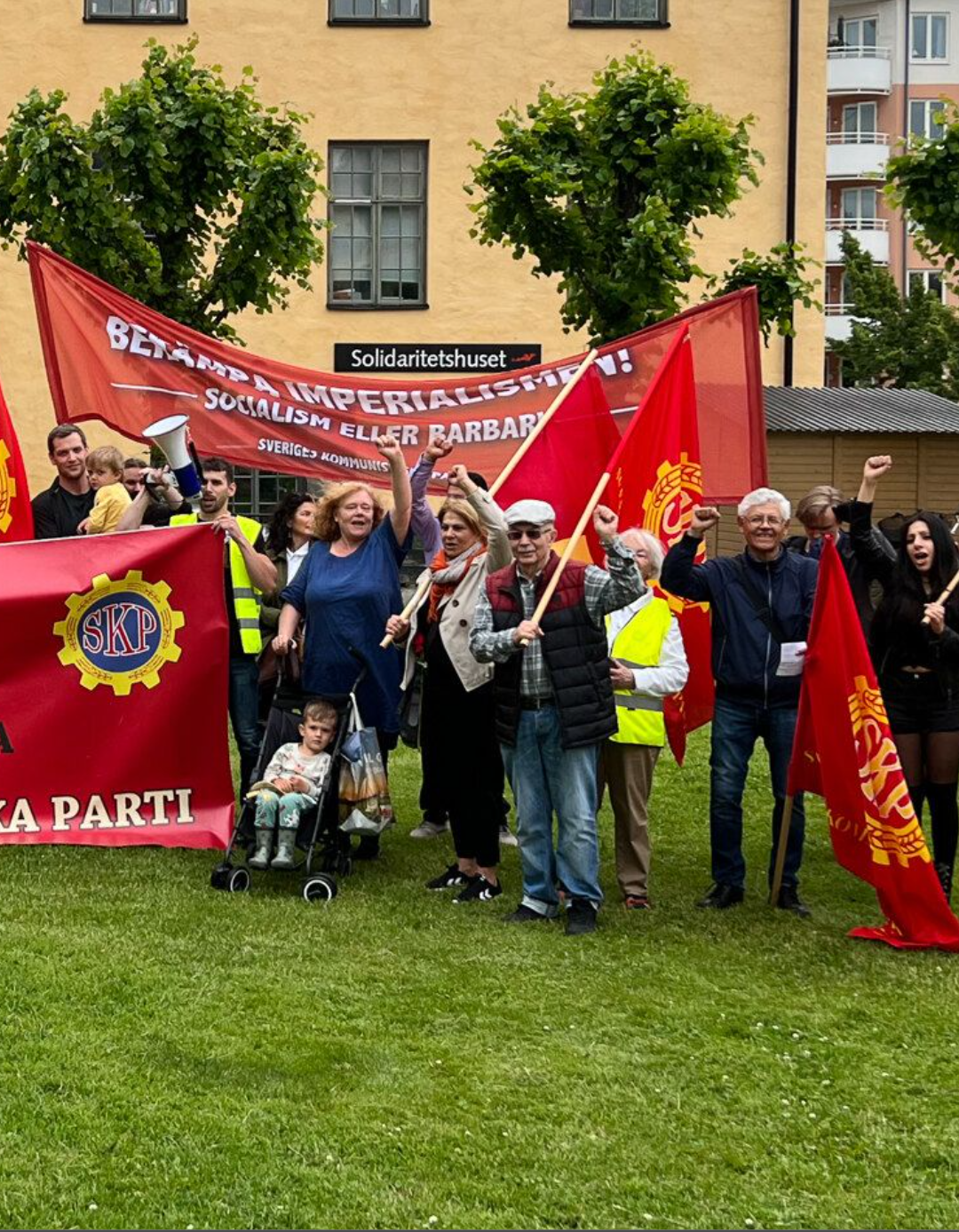

Sunday, May 22, 2022


Sunday, May 15, 2022
Radda LAS och Nej till NATO @ Karlstad Sol Torget
Rädda LAS aktion: May 14th, 2022 @ Karlstad, Sol Torget:

KP och Marxistiska Studenter


Rädda LAS
 ak
akRädda LAS
Nej till NATO speak-out, May 15th, 2022 @ Karlstad, Sol Torget.

KP / SKU

SKP

KP / RKU
Monday, May 2, 2022
marxistiska första maj 2022 i karlstad

SKP och SKU

Marxistiska Studenter

SKP Litt Table @Sol Torget

SKP Litt Table @ Sol Torget

med Marxistsika Studenter @ V block
Sunday, April 24, 2022
SVERIGES POSITION I DEN IMPERIALISTISKA HIERARKIN

THE POSITION OF SWEDEN IN THE IMPERIALIST HIERARCHY:
"Capitalism-imperialism is today characterized by an increasingly acute and serious competitive situation. More countries, mainly Russia and China but also other imperialist blocs, are challenging the United States, which since the end of the Second World War has occupied a special position within the system. Through various organisations, associations and agreements, such as the EU, BRICS, ALBA and NATO, the capitalist countries are trying ever harder to assert themselves in the face of fiercer competition. The rifts are increasing, leading not only to trade wars, but also to regional wars over transport routes, markets and natural resources."
"The present situation, in which US dominance is being challenged from several quarters, is an expression of the uneven development of capitalism, in which some countries and monopolies gain advantages, which are later captured by other countries and monopolies. This is the way things are going, which is constantly sharpening the contradictions and forcing a new need for the destruction of capital, including in the form of war: in an economic system where everyone has to grow, it is perfectly possible to grow even on ruins."
"In the imperialist system, Sweden occupies a relatively prominent position. With a highly concentrated capital, an efficient state and large interests abroad, the Swedish monopolies are actively participating in the redivision of the world. This is manifested by an increasingly active participation in international associations, such as NATO and the EU, whose defence cooperation involves powerful military build-ups and preparations for war. This also reflects the Swedish monopolies' need to join forces with stronger players in order to gain advantages."
"Swedish capitalism has benefited both from the counter-revolution in Eastern Europe and from membership of the EU, which has brought advantages mainly through the penetration of the markets opened up in the former socialist states, but also through the opening up of the intra-European market to the Swedish monopolies."
"The Swedish monopolies' quest for greater profit leads them to join both the EU and NATO, through which they can even more effectively guarantee their international position. This is a natural development which for the moment favours Swedish capitalism and which hardly implies a subordination on the Swedish side, a loss of national sovereignty or Swedish self-determination. In an advanced capitalist country like Sweden, the question of the power and self-determination of the nation can never lead us, but we actively seek to resolve the question of the power of the working people within the nation."
"This means that we face the accelerating imperialist contradictions of recent years without any illusions that these can be contained by reforms in the capitalist countries or in the UN. Our struggle for peace must at the same time be a struggle for the power of the working people, because it is the only power that can guarantee peace."
"We have no hopes that the politicians of capitalism will create peace or the conditions for human prosperity. They are the representatives of capitalism and the capitalist state and their ultimate aim is to strengthen the position of the Swedish monopolies in international competition."
***
Credit for the cited and translated text belongs to Sveriges Kommunistiska Parti.
The views expressed by Sveriges Kommunistiska Parti are not necessarily those of Emmanuel Goldstein, the New Seditionist Weblog and vice versa.
***
See also:
The History of "New Sweden" in Delaware
https://en.wikipedia.org/wiki/Swedish_overseas_colonies
Sunday, March 27, 2022
Global Climate Strike (March 25, 2022)
FATHER STATE RAPES MOTHER NATURE
 |
| Climate Justice = Social Justice ! |
*pic from Karlstad, Sweden.
Friday, December 10, 2021
Marxist Critique of Metamodernism II
You measure a democracy by the freedom it gives its dissidents, not the freedom it gives its assimilated conformists. - Abbie Hoffman
#
YouTube/Marxist Critique of Metamodernism: https://youtu.be/eeCGgZgHdHk
#
Marxist Critique of Luke Turner's Metamodern Manifesto (2011):
(by Comrade Niklas)
I read the manifesto by Luke Turner and to be honest it is full of the same pompous yet incomprehensible language as all the postmodernist texts. To me it’s not clear if he actually rejects any of the core concepts of postmodernism. He says that “we must liberate ourselves from the inertia resulting from a century of modernist ideological naivety” and that “we acknowledge the limitations inherent to all movement and experience”, and “all information is grounds for knowledge [...] no matter its truth-value”. All of this sounds very postmodern. He says that we should act as if we can transcend the limitations of movement and experience. Clearly hinting that the limitations are real, but that we should act like they don’t exist. Hence he is not really contradicting the fundamental postmodernist proposition that objective knowledge is impossible at all! He is proposing a kind of morality or way of thinking based on a lie. According to him (and according to postmodernism) we can’t know if objective truth and progress really exist, but if we pretend that it does this would make our existence “richer” and help to “unfold” the world.
This again is a very idealist and postmodernist approach to reality: essentially what he is saying is that we can change or even create reality by changing the way we think about it. “Thus, metamodernism shall be defined as the mercurial condition between and beyond irony and sincerity, naivety and knowingness, relativism and truth, optimism and doubt, in pursuit of a plurality of disparate and elusive horizons.” To me this is just meaningless chatter, very much like postmodernism.
The capitalist crisis results in people looking for a way out of this system. They will start to look for ideas that can give them solutions. This also leads to criticism of postmodernism - this is true. But postmodernism has not been replaced by something different and is not “out”. The war against postmodernism has only just begun.
The reasons why Marxists are focusing their critique on postmodernism and not post-postmodernism or metamodernism is this:
1. Postmodernism is still the dominating philosophical trend in both academia and much of politics.
2. Post-postmodernism is not really a thing. The real basis for the cultural and political trends that we see today is the deepening crisis of capitalism.
3. Metamodernism is neither very important nor a clear break from postmodernism.
N.H.
Saturday, October 23, 2021


Thursday, August 26, 2021


Sunday, August 15, 2021
Venezuela: Political Manifesto of the Popular Revolutionary Alternative.

***
Political Manifesto of the Popular Revolutionary Alternative (APR)
11 August, 2021[Spanish original: https://luchadeclases.org.ve/?p=9762]
The document published below is the proposed Political Manifesto of the Popular Revolutionary Alternative, drafted by the congressional commission and approved by the national political commission as a draft manifesto of this political platform, to be discussed, modified and/or approved by the local nuclei of the APR and subsequently by the national congress of the platform.
The Popular Revolutionary Alternative (APR) is a coalition of progressive and anti-imperialist parties, movements and organisations, grouped under the interest of building a new political reference at the service of the workers', peasants', communal and popular struggle. This initiative arose from numerous coincidences reached between a group of left organisations, in order to resist the imperialist aggression against Venezuela and the new pact between the traditional bourgeoisie and the national government, which is expressed in opulence and privileges for the old and new rich, and in misery, hunger and dispossession for the vast majority of the people.
Those of us who make up the RPA believe in the importance of taking stock of the national and international context that surrounds us, which calls us to raise our voices to accompany the various signs of popular resistance and to build, hand in hand with the people, a political proposal that aims at the revolutionary overcoming of the crisis of the capitalist system.
International context
Since the outbreak of the 2008 crisis of capitalist overproduction, which manifested itself under the guise of a "financial crash", the world has entered a spiral of economic stagnation and decline from which it has not been able to recover. The reason for this is the structural nature of the crisis, which has exposed the historical limits of the capitalist mode of production. Today, this system not only shows that it is powerless to solve the great scourges afflicting humanity, but its tendency is to deepen them as it concentrates the enormous social wealth in the hands of an ever smaller handful of entrepreneurs, bankers and landowners.
While numerous governments allocated ambitious financial packages to bail out the banks and private companies, the working masses saw their jobs, gains and fundamental rights being lost. The capitalist governments took it upon themselves to unload the full weight of the crisis on the shoulders of the workers, through aggressive policies of public spending cuts, hikes in utility rates, measures of labour flexibilisation and casualisation, increases in the minimum retirement age, reduction of pensions and subsidies, as well as a general assault on democratic rights in many countries.
This neoliberal offensive led to an escalation of the class struggle, expressed in countless mobilisations and popular uprisings around the world. Such a climate of tensions emerged in the run-up to the outbreak of the Covid-19 pandemic. Although at first these popular uprisings were calmed down by the health emergency and the resulting containment measures, from the end of 2020 onwards we can observe the resumption of broad mobilisations and social struggles, but now enhanced by the effects of the pandemic on the precariousness of living conditions.
For their part, the global pandemic, while deepening the capitalist crisis, is being exploited by the bourgeois and imperialist elites to further increase their wealth. An example of this is the business of the Covid-19 vaccines (despite the fact that most of them were financed with public funds) and the lucrative activity of the multinational pharmaceutical companies, which refuse to cede the intellectual property rights for the production of doses in new laboratories. The individual capitalist profit motive has prevailed over the general interest of saving the lives of the world's population.
On the other hand, the gigantic financial rescue packages implemented by the governments mean that sooner or later the capitalist elites of all countries will want to burden the workers. Such a reality will exacerbate the climate of social tension and class struggle worldwide.
As we can see, the crisis of capitalism is far from being solved. The international organisation of the workers is imperative in order to find a revolutionary way out of the crisis of the decaying capitalist social order. The APR in Venezuela is called to play a role in this process at the national and Latin American level.
The Venezuelan national process
In Venezuela, since the beginning of oil extractivism at the beginning of the 20th century, a national form of capital accumulation governed by oil rent has been established. The enormous weight of this rent in the economic dynamics of our country has a determining influence on the levels of national backwardness and dependence. The Creole bourgeoisie and the foreign capitals that have operated in the country are only driven by the parasitic eagerness to increase their own value through the appropriation of the oil rent, hence their historical inability to lead a process of national industrialisation.
100 years of rent-seeking and bourgeois management in Venezuela have resulted in a de-industrialised economy, the abandonment of agricultural activity, dependence on imports, fraudulent capital flight and a high level of administrative corruption.
This form of backward and dependent capitalism has condemned the historically oppressed majority to survive on low wages, unemployment, poverty and exclusion. Although during the economic history of oil-producing Venezuela there have been periods of bonanza, which have led to slight improvements in the living standards of the working people, these have always been followed by periods of deep and prolonged crisis, in which the gains achieved are pulverised and the levels of misery expand again. This was the case of the boom of the late 1970s, which gave way to the crisis of the 80s and 90s of the previous century, and the imposition of the anti-worker and anti-popular recipe book of the International Monetary Fund.
From that process of neoliberal adjustment came the popular outbreak of the Caracazo in 1989, and the subsequent breakdown of the fourth-republican bipartisanship in the political system. It was in this context that the figure of Hugo Rafael Chávez Frías emerged as an expression of the patriotic and progressive military forces that opposed the anti-popular and repressive policies of the governments of the time. Hugo Chávez's leadership was able to unify the broad popular movement that had been fighting for decades for profound changes in a country hard hit by poverty, misery and social inequality.
The triumph of the patriotic and progressive forces in the 1998 presidential elections made it possible to initiate a process of progressive changes based on a fairer distribution of oil revenues. This led to policies to increase social spending, re-establish labour rights, expand public services (especially the health and education systems), programmes to distribute food at affordable prices and measures to combat large estates, all of which had a positive impact on the living conditions of the population and reduced poverty rates.
The character of the current crisis
Despite the numerous advances achieved by the Bolivarian process in the fields of law, demands and the development of new forms of popular organisation, these changes took place within the limits of dependent and rentier capitalism. In little more than 20 years of the Bolivarian process, the rentier economic model, far from undergoing changes, advanced towards its most extreme forms. Hence the incredible indicators of foreign indebtedness, capital flight, dependence on imports, dismantling of national production, inflation rate and deterioration of the national currency.
By 2014, when international oil prices fell and foreign debt commitments began to expire, the Venezuelan state's income collapsed, starting the new episode of structural crisis of Venezuelan capitalism, which is still in force. This scenario worsened with the collapse of oil production and later with the application of the first illegal foreign sanctions in 2017.
The government of President Nicolás Maduro is in charge of personifying the anti-popular adjustment in the face of the abrupt fall in oil revenues. The punctual payment of the foreign debt, which meant the disbursement of 110 billion dollars during the period 2014-2017, and the agreements with the most concentrated national and foreign private capital to guarantee them the allocation of available foreign currency, marked the beginning of an adjustment plan applied progressively. The immediate effects were manifested in acute shortages of food, medicines and essential consumer goods, hyperinflation, business closures, falling wages, dismantling of social gains and increasing deterioration of public services.
In addition to the above, US imperialism has promoted a significant number of financial and trade sanctions against the Venezuelan state, which have had a brutal impact on the accelerated decline of the economy and the living conditions of the population. There is no doubt that the aim of the imperialist aggression is to economically suffocate the Venezuelan government, in order to create the conditions for a political change favourable to the US plans of domination.
In this direction, the White House has not ceased its systematic attack seeking to generate internal destabilisation, promoting coup conspiracies and even the recognition of a parallel (fictitious) government, through its puppet Juan Guaidó.
The new pact of the elites
The capitalist approach to the crisis and the effects of imperialist sanctions, was consolidated with a pact of elites, between the government-PSUV with various right-wing parties, FEDECAMARAS and other business associations, with a view to stimulating and favouring profits for the bosses' sectors. In this sense, government policy in recent years has done nothing more than make the workers of the countryside and the city pay for the crisis.
Thus, all kinds of anti-worker and anti-popular measures have been applied, such as: bonuses and wage restraint, the imposition of Memorandum 2792, the liberalisation of prices, measures to facilitate the process of informal dollarisation of the economy, the privatisation of public companies, the intention to surrender our national sovereignty with the Special Economic Zones (SEZ) and the Anti-Blockade Law, the conservative turn in gender policies and impunity for violence against women, among others. Likewise, in the Venezuelan countryside, the recomposition of landowners and large landowners has been carried out through intimidation, persecution and assassination of rural leaders and workers.
The implementation of this neo-liberal policy has been accompanied by an increase in the repressive and arbitrary tendencies of the state, by curtailing trade union rights, criminalising protests, criminalising different workers' and popular fighters, taking away electoral cards and violating the political rights and democratic freedoms of the working class.
The deep corruption in the state apparatus and the looting of the public treasury has given way to the formation of a layer of nouveau riche, who not only dabble in business, industry and commerce, but also comprise a community of interests that increasingly influence the course of the national government's economic policy. This can be seen in the way these new capitalists benefit from price liberalisation policies, tax exemptions on imports and privatisation policies or the transfer of public enterprises.
After internalising the failure of the policy of "cessation of usurpation, transitional government and free elections" and given the full willingness shown by the Maduro government to build a broad national agreement to push forward its programme of capitalist adjustment, today the traditional oligarchy is more willing to negotiate with the government than in the past. In general terms, the bourgeoisie agrees with Maduro's economic and legislative programme. Their differences lie in the unequal way in which these measures benefit to a greater extent the so-called "revolutionary bourgeoisie" because of their preferential links with the government, so they demand greater openness and guarantees for the private sector they represent.
In short, the government, the right wing and imperialism are sitting down to negotiate the future of Venezuela, at a table where the interests of the workers and the popular sectors are excluded. The severe impact of the economic crisis on the living conditions of the working people, as well as the criminalisation and judicialisation of workers' and popular struggles, have led to the development of a process of demobilisation, depoliticisation and social apathy.
Faced with this complex situation, the organisations that make up the RPA express our deepest repudiation of the interventionist and punitive measures promoted by US imperialism against our country. We also reject the surrender and neoliberal policy of the national government, which, while it generates concessions and advantages of various kinds for private capital, tries to continue to make the working people pay the bills for the crisis.
Organising the resistance struggle of the workers', peasants', communal and popular forces against the capitalist adjustment implemented by the new pact of elites is a necessary and vital task. The RPA must play a fundamental role in bringing together the forces fighting against the neo-liberal offensive on the social gains of the Venezuelan people. We are called to build the Alternative that will open channels for the political, economic and social changes that are indispensable to overcome the dependent and rentier economic model, and move towards the construction of socialism.
The Popular Revolutionary Alternative on a fighting footing
The Popular Revolutionary Alternative has emerged as a historical necessity. It is the crystallisation of years of debate within the left about the need for its independence. Although we emerged in the midst of an electoral juncture (the 2020 parliamentary elections), we understand that only the organisation and mobilisation of the working, peasant and popular majorities will open the way to a better tomorrow. It is necessary to direct all our efforts to increase the capacity of organisation and mobilisation of the exploited and oppressed of society, in the midst of a context that aims at the depoliticisation of the majorities.
Our aim is to build a free, just, united and egalitarian society. Our aim is to achieve a socialist society, but not the "socialism" of the rich and nouveau riche allied with the government, which is in reality a savage and predatory capitalism. We want to build a socialism in which the economy is planned in the interests of the people, in which the scourge of corruption is definitively extirpated and in which education, health and social security are a priority.
We want our children to have quality education in schools, a liberating education that awakens in them the ability to think critically and to intervene in political affairs. We want our grandfathers and grandmothers to be able to have a dignified old age, with pensions that cover their needs. We want to have access to truly public services, of quality and for all. We want one job to be enough to cover our needs, with stability and social security. We want a society of truly equal people, regardless of their gender identity, ethnicity or religion. A society where women can live free from violence.
In the face of imperialist aggression, the pact of elites and the neoliberal adjustment against the Venezuelan people, the political forces grouped around the RPA say to the Venezuelan people: Yes, there is an alternative!
Let's continue to build hope!
***
Source: https://luchadeclases.org.ve/?p=9762
*Please translate into your language and disseminate widely, but link to the source.
Tuesday, May 9, 2017
Aktion Against Deportation
In 2013 I was active with the Aktion Against Deportation collective in Sweden, these are some of their postings on Facebook. You can visit the Aktion Mot Deportation facebook page for more.
(10) 2013-2014 Aktion mot
Deportation (Sweden)
I first came across the
work of the Aktion mot Deportation network on Facebook. In 2013 the
Swedish government ordered the police to actively work to aprehend
undocumented immigrants. Police were deployed to stop random people
on the streets and in the subway in Stockholm asking for papers. In
context of the ID checks, the police engaged in racial profiling in
order to decide who to stop. This was clearly a racist methodology.
The Aktion mot Deportation network movilized to warn undocumented
immigrants via social media about places where the police had set up
checkpoints in the city. It also organized demonstrations to protest
the round up and to protest subsequent deportations of captured
Afghans and Iraqis.
A scripture that inspired me to become involved with Aktion mot Deportation was Exodus 23:9: "You shall not oppress a foreigner. You know the heart of a foreigner, for you were foreigners in the land of Egypt." The Bible in many other passages expresses the will of God as being manifest against the oppression of "the stranger" and "the foreigner".
 |
| Demonstratiojn in solidarity with immigrants in detention. |
The Aktion mot
Deportation network defines itself as "a social movement
working for the release of all refugees imprisoned in detention
centres and against deportations." The
network denounces the systematic use of repression by police to
enforce deportations: "It's a common practice that
when you are to be deported from the detention centres of the
Migration Board [Migrationsverket], police officers wake you up in
the middle of the night when you're unprepared, to prevent you from
mustering any resistance. It is also common for the police
to use coercion, violence, drugs, shackles and other means of
restrictions to get you onto the plane. Since 2009, the
Migration Board, the police and the government have escalated the use
of force: they declared a "year of readmission" with
increased persecution and specially chartered planes for mass
deportations." The Swedish
government decides to not pay any attention to human rights issues as
they aply to refused asylum seekers. Abuses of the human rights of
refused asylum seekers and the undocumented are rampant in the
system: "Sweden has continued the forced deportations
to Iraq, despite criticism from human rights organizations and
despite repeated pleas from the Iraqi government to cease. During the
last three years, 1691 people have been deported to Iraq from Sweden.
The ones who are incarcerated before the deportation have
been arrested at their work places, on the way home from school,
going out to get groceries or similar situations. These
are people who have made their lives in Sweden, people who work or
study, who have built families and social circles and in other ways
have become part of Swedish society. Only to be torn away from their
lives and thrown out of the country." The
Aktion mot Deportation network works towards changing immigration and
asylum laws and policies to conform to human rights and the values of
solidarity. It specifically works to raise awareness about the human
rights situation of people incarcerated in detention centers:
"Aktion mot deportation is a social movement for migration and
asylum policies that are open and based on solidarity, against the
practice of forced deportations and incarceration in detention
centres."
Aktion mot deportation
demands: "(1) An immediate stop of this violence and
dehumanization, (2) That all deportations cease, and (3) The release
of all those incarcerated in detention centres."
 |
| Stop Deportations to Afghanistan. |
The Aktion mot Deportation network advocates the use of direct action tactics in order to stop deportations: "We also want to emphasize the responsibility of all human beings, as keeping silent means an approval of the deportation machinery. Protests, blockades and dissemination of information are some of our tools, but we are constantly looking for new ways. We therefore urge police officers, pilots, airport staff, staff at detention centres, travel agents, bus companies and others who take part in the transportation of refugees: Lay down arms! Refuse, defect or talk your colleagues out of participating in deportations, incarcerations or preparations for the deportations!" Although I respect the viewpoint of the Aktion mot Deportation network in seeking to appeal to the sense of moral solidarity with immigrants of those involved in the mechanism of deportations, it is my personal opinion that appealing to individual police officers to not collaborate with deportations is naïve. The police under capitalism are the armed fist of the state, they exist primarily for the purpose of repression. Their job is to brutally repress the undocumented.
In a
letter I emailed to Aktion mot Deportation in context of the
protests; I made a positive non-violent direct action proposal to
fight against the police ID checks in Stockholm. I presented the idea
of organizing a one week immigrant (and citizen allies), boycott of
the Stockholm Tunnelbanan (subway) system modeled on the 1957
Alexandra Bus Boycott (South Africa), the Bristol Bus Boycott of 1963
(United Kingdom) and the Montgomery Bus Boycott of 1965 (United
States). I pointed out that historically, these boycotts of the local
transportation system constituted the spark of civil right movements
that led to the eventual downfall of oppressive social segregation
systems in South Africa, Britain and the United States. I proposed
that we need an immigrant "Rosa Parks" type figure
(preferably an African Muslim Woman) to be the face of the boycott to
the media and that such an action would demonstrate to the government
and to public opinion in general the collective economic power of the
immigrant population in Stockholm, it would also depress the profits
of the subway system placing more pressure on the government to back
off the controversial ID checks until courts rule on their legality.
I proposed that we approach the churches to help organize the boycott
as well as a series of legal challenges to test in court the legality
of the policy of ID checks. This combination of boycott action and
legal challenges is what led the way to the eventual demolition of
Jim Crow segregation in the southern United States in the 1960's. I
argued that the police ID checks were ethically objectionable from a
social justice perspective because they were premised upon racial
profiling and potentially violate civil liberties; because the police
cannot ask for ID’s unless a person is suspected of criminal
activity. Being undocumented is not a crime; it is only an
administrative infraction.
The
Human Rights Case Against Deportations:
 |
| Stop Deportations to Afghanistan. |
In my view, the fundamental problem is that Nation States operate on the premise that they have a "sovereign right" to ignore and declare ''non-binding'' fundamental human rights guaranteed by the United Nations Human Rights Charter. Under the current system of international law, the sovereign rights of states are considered above the human rights of persons. The forced removal of Afghan and Iraqi asylum seekers to a war zone is in fact a crime against human rights. The asylum seekers human rights movement should call for a moratorium on deportations to Afghanistan until the war is officially over as well as an amnesty for Afghan asylum seekers under the age of 18. Everyone, including all migrants and asylum-seekers, have the right to liberty and freedom of movement. In principle, migrants and asylum-seekers should not be detained for migration control purposes. Seeking asylum or being in an irregular undocumented situation is not a crime. The policy of detention must be abolished.
The Universal Declaration of Human Rights is very clear on the issue of immigration and seeking asylum. Deportations are contrary to Human Rights of Immigrants:
Article 13.
(1) Everyone has the right to freedom of movement and residence within the borders of each state.
(2) Everyone has the right to leave any country, including his own, and to return to his country.
Article 14.
(1) Everyone has the right to seek and to enjoy in other countries asylum from persecution.
(2) This right may not be invoked in the case of prosecutions genuinely arising from non-political crimes or from acts contrary to the purposes and principles of the United Nations.
(1) Everyone has the right to seek and to enjoy in other countries asylum from persecution.
(2) This right may not be invoked in the case of prosecutions genuinely arising from non-political crimes or from acts contrary to the purposes and principles of the United Nations.
The police repression being meted out to asylum seeker activists in Europe (specifically during the 2013 asylum seeker protests in Munich, Germany and Brussels, Belgium), is a direct attack upon the political rights of migrants, rights guaranteed by the Universal Declaration of Human Rights. There is nothing contrary to the purposes and principles of the UN in seeking asylum.
On the issue of Afghan asylum seekers who have converted to Christianity and risk being killed if deported to Afghanistan the UDHR is again very clear on the matter:
Article 18.
Everyone has the right to freedom of thought, conscience and religion; this right includes freedom to change his religion or belief, and freedom, either alone or in community with others and in public or private, to manifest his religion or belief in teaching, practice, worship and observance.
The work of the Aktion mot Deportation network and protests by immigrants against deportation and other abuses is also protected by the UDHR:
Article 19.
Everyone has the right to freedom of opinion and expression; this right includes freedom to hold opinions without interference and to seek, receive and impart information and ideas through any media and regardless of frontiers.
Article 20.
(1) Everyone has the right to freedom of peaceful assembly and association.
(2) No one may be compelled to belong to an association.
 |
| Encourages passengers on commercial flights to act in protest of deportations. |
The reason nation states consider the Universal Declaration of Human Rights 'non-binding', is that its enforcement would spell the end of the arbitrary system of power relations which sustain the elite status of the political classes who administer the international nation state system. The ''legitimacy'' of nation-state power is based upon monopoly of violence; i.e. the assemblies of armed men called police and military. The nation states of Europe in particular are administered by technocratic bureaucracies and an entrenched professional political class; these elements constitute an elite strata similar to the 'nomenklatura' in the former Soviet Union. The facade of ''parliamentarism'' is in fact an oligarchy. The power of the nation-state rests upon its ability to deploy armed force in order to impose the political will of the state over persons. ''Social cohesion'' is maintained on the basis of the threat of force and through mass surveillance. The obsolete nation-state system rests on a throne of bayonets. The nation-state is in fact a concentration of political and economic power that claims ''soveregnity'' on the premise of socially constructed national myths. The protection of the national myth is the basis for the convenient declaration of universal human rights standards as ''non-binding''.
If those who govern the European nation state system consider the Universal Declaration of Human Rights to be 'non-binding'; then those who struggle for a world without borders and for the rights of the undocumented and of refused asylum seekers are justified to deploy the tactics of direct non-violent civil disobedience against the police state tactics of the government; repressive tactics which serve as the foundation for the migration control regime. The struggle against deportation is the struggle for human rights, against the abuse of state power by the political class and a struggle against the police state.
#
Subscribe to:
Posts (Atom)